


Table of Contents
Introduction
the concepts of “due process of law” and “procedure established by law,” which are frequently discussed in relation to Article 21 of the Indian Constitution. A strong understanding of these concepts is crucial for UPSC Civil Service Exam aspirants.
Procedure Established by Law
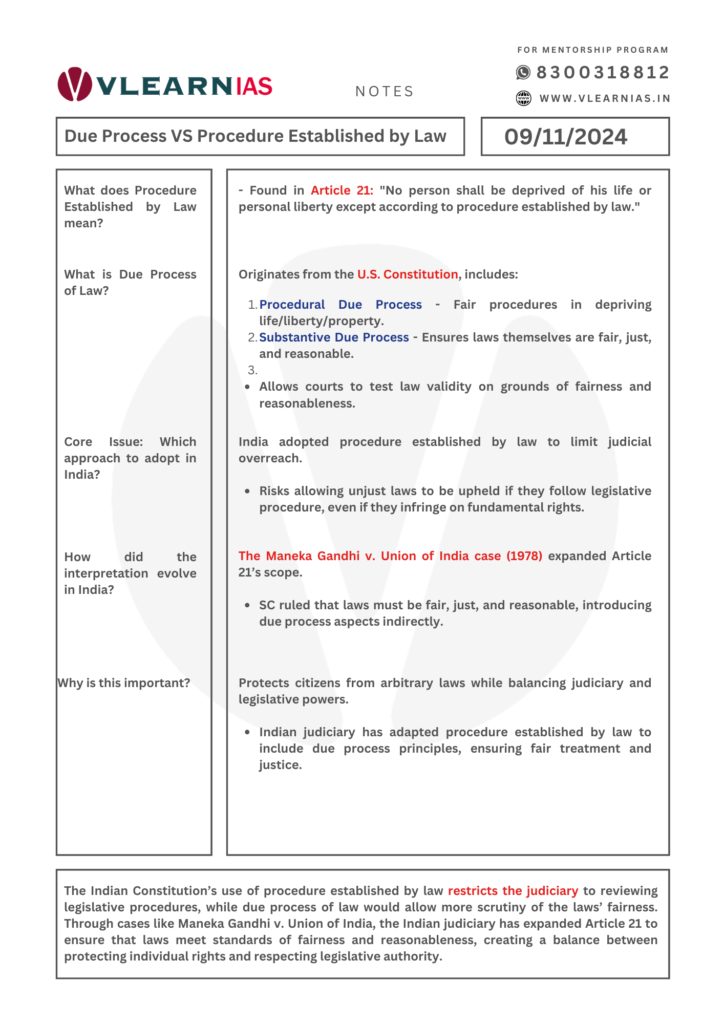
- Article 21 of the Indian Constitution states: “No person shall be deprived of his life or personal liberty except according to procedure established by law.”
- This phrase means that the deprivation of an individual’s life or personal liberty is permissible only if it adheres to a procedure that has been legislated by a competent authority, such as the Parliament or State Legislature.
- The judiciary’s role is limited to verifying the existence of a law authorizing the action and ensuring that the prescribed procedure outlined in that law has been followed.
- The court does not assess the law’s reasonableness, fairness, or justness, as long as it has been appropriately enacted by the legislature.
- Example: If the government passes a law that restricts individual freedom by mandating specific actions, as long as the law’s procedure is adhered to, it will fulfill the “procedure established by law” requirement in India.
Due Process of Law
- “Due process of law” is a broader concept originating from the Fifth and Fourteenth Amendments of the U.S. Constitution.
- It aims to ensure not only procedural fairness but also substantive justice.
- It encompasses two main components:
- Procedural Due Process: Mandates that the government follows fair procedures before depriving a person of life, liberty, or property.3
- Substantive Due Process: Scrutinizes the fairness, justness, and reasonableness of the laws themselves. It empowers the judiciary to strike down laws that infringe upon fundamental rights or are arbitrary.
- Under “due process of law,” the judiciary holds the power to evaluate the validity of a law based on fairness, reasonableness, and justness.
- Example: If a law is unjust or violates fundamental rights, the “due process of law” principle authorizes the judiciary to declare it unconstitutional, even if it adheres to the proper procedures.
Procedure Established by Law” vs. “Due Process of Law
- The framers of the Indian Constitution opted for “procedure established by law” in Article 21 due to concerns that “due process” might lead to excessive judicial intervention in legislative matters.
- A potential drawback of the “procedure established by law” approach is that it could allow unjust laws to remain valid if they follow the correct procedure, even if they violate principles of justice or fundamental rights.
Evolution of Judicial Interpretation in India
- The Indian judiciary has progressively broadened the scope of Article 21 by incorporating elements of due process into the interpretation of “procedure established by law.”
- This shift began with the landmark Maneka Gandhi v. Union of India case (1978).
- The Supreme Court, in this case, ruled that the “procedure established by law” under Article 21 must not only be legally valid but also just, fair, and reasonable.
- This judgment effectively introduced the “due process” aspect indirectly without explicitly using the term.
- Through various rulings, the Court has interpreted Article 21 to include the requirement for laws to meet standards of fairness, justice, and reasonableness, thus making the Indian judiciary a protector of individual rights similar to the U.S. system.6
Conclusion
- The debate between “due process of law” and “procedure established by law” highlights the balance of power between the judiciary and the legislature in India.
- By integrating fairness and reasonableness into “procedure established by law,” the judiciary has adopted a quasi-judicial activism role in safeguarding rights while respecting legislative authority.
- This approach enables the judiciary to protect citizens from arbitrary laws while ensuring that the legislature retains its law-making function.
- In essence, while “procedure established by law” remains the official doctrine in the Indian Constitution, the interpretation of Article 21 has effectively incorporated elements of “due process”.7 This allows the judiciary to uphold the principles of justice, fairness, and reasonableness, demonstrating how the Indian judiciary has adapted constitutional interpretation to protect fundamental rights while respecting the boundaries of legislative power.